My thanks to Chris Firkus, who answered my question this week about how a stonefly changes from breathing water through gills as a naiad to breathing air as an adult. Here's the answer he posted on facebook:
"The gills are directly attached to the spiracles and are a continuation of the internal circulatory system to the gills. Then when they shed the gills at the spiracle, the spiracle is what is left. Both are passive respiration by diffusion."
Chris will be receiving an original Trout Lily Studios woodblock print in thanks for his answer. I'm very grateful for his input, and for satisfying my curiosity where Google failed.
Keep an eye out for the next post!
Monday, July 15, 2013

Saturday, July 13, 2013
Stoneflies
 There are around 1600 species of
stoneflies in the world, 450 of which are to be found in North America, and yet
I found that I knew next to nothing about them. I suspect I’m not the only one,
and I hope to remedy that with this Things from the Shelf.
There are around 1600 species of
stoneflies in the world, 450 of which are to be found in North America, and yet
I found that I knew next to nothing about them. I suspect I’m not the only one,
and I hope to remedy that with this Things from the Shelf.
I
recently went on a tubing trip with my dad down the Apple River. The weather
cooperated, the river was clear, and we only had one spot where we had to get
out and clamber over a fallen tree. The only problem I encountered was the fact
that my tube had sprung a leak, so I could hear it bubbling the entire trip and
I was riding about five inches deeper by the time we pulled out.
Otherwise, it was great. The Apple
River that runs through my grandfather’s land is beautiful, with trees lining
the riverbanks on either side and deep fish ponds where I could flail free of
my inner tube and dive. There were a few close calls—I nearly got taken out by
a duck house that was staked in the middle of the river—and some of the fallen
trees that we passed underneath were close enough that we had to lean in order
to slip under.
There’s a lot of wildlife out there
on the river, secluded from human civilization as we were. My dad acquired a
spider passenger after we went under a log at one point—I’m thinking it was
some sort of orb weaver—and there were swarms of damselflies of all colors
ranging along the banks that would alight on your arms or legs if you sat very
still as you went by.
Now, as we were passing some rocks
not far from the park where we pulled out, I noticed that the rock was peppered
with little gray shapes. I was waiting for my dad to get through the rapids, so
I anchored myself on the rock and took a closer look to pass the time, and
found that they were stonefly sheds. Stoneflies, for those who don’t know, are
very closely related to the cockroach. They’re long of body—from six to fifty
millimeters in length—with long, veined, transparent wings that fold up
crosswise over their back, hence their scientific name—‘Plecoptera’ meaning ‘twisted’
in Greek.


What I was finding was the sheds from the
partially-grown naiads. Stoneflies go through what is known as incomplete
metamorphosis, meaning they don’t make sudden, definite shifts from one stage
in life to another like a caterpillar metamorphosing into a pupa and on into a
butterfly. Instead, they develop gradually into an adult over a period of
instars—growth stages between sheds—until their wings have fully developed and
they can leave on their mating flight. The
naiads look a lot like the adults, save without wings. They have a wide, flat
head, a three-sectioned thorax, and a segmented abdomen from which branches a
pair of tails (or ‘cersi’). The wings begin developing partway through their
metamorphosis as little sacs on their backs, and will grow steadily until they
reach their adult stage.
The adult stoneflies deposit their
eggs in fast-moving rivers, so the naiads naturally must be adapted for life on
the river bottom. Their bodies are flat, with the strong, anchoring legs
splaying out from the sides so that they can cling to rocks in fast currents
and let the water rush right over them. They’re also equipped with gills, which
appear as tiny, hair-like structures growing on and around the thoracic region,
mostly where the legs meet the body. They anchor themselves on rocks in the
center of the current, and seem to prefer fast, cold, highly oxygenized water.
If there isn’t enough oxygen for them to breathe, they’ll perform ‘push-ups’ in
order to move more water over their gills.
When the adults hatch, they don’t
have much for mouthparts. They will have chewing mandibles, but these tend to
be nonfunctional since the adults usually don’t live long—from a few hours to a
few days—though they do survive a little longer than the average mayfly. They
immediately rise to mate, and afterwards the female will either lay her eggs
near the surface of the water or dive beneath the surface to lay them on the
bottom. The eggs have adapted just as the naiads and adults, and are equipped
with either a sticky substance or some sort of anchor to fasten them to the
river bottom. After eight to ten months, the eggs hatch, and the process starts
all over again.
 The sheds that I found ranged in
size from an inch to half an inch, and I was told that they were small
compared to what they would become later on during their metamorphosis. After
my dad caught up, I decided that on the next cycle through, I would bring a jar
and collect some of the sheds. I did that, and put it in a bag and tied it
around my waist. After the beating I dealt it coming down the river the second
time, I’m surprised it was still intact, and yet somehow I was able to not only
keep the jar, but also find the rock where I’d seen the sheds and collect a
good dozen or so for my shelf museum. A week later, I realized I still didn’t
have a post ready for the weekend, so I pulled out the box of stoneflies and
began researching.
The sheds that I found ranged in
size from an inch to half an inch, and I was told that they were small
compared to what they would become later on during their metamorphosis. After
my dad caught up, I decided that on the next cycle through, I would bring a jar
and collect some of the sheds. I did that, and put it in a bag and tied it
around my waist. After the beating I dealt it coming down the river the second
time, I’m surprised it was still intact, and yet somehow I was able to not only
keep the jar, but also find the rock where I’d seen the sheds and collect a
good dozen or so for my shelf museum. A week later, I realized I still didn’t
have a post ready for the weekend, so I pulled out the box of stoneflies and
began researching. 
For the most part, I found out
everything I wanted, but unfortunately, there’s something I’m still curious
about: How does the circulatory and respiratory system of the stonefly shift from
breathing water through gills to breathing air through little holes (called ‘spiracles’)?
So far, I’ve had no success with Google. If any of my readers can figure out
the answer, I would greatly appreciate it if they would post in the comments
section below, and I will be sure to share the answer on the blog for all to
see.
Happy
reading!
S. R. Koch

Resources:
Saturday, June 29, 2013
Dragons
Something quiet and nostalgic for anyone who's ever wondered what else was out there.
Dragons
By
S.R. Koch
Dragons live in the north. It’s their
homeland. Their race was born from the roots of a great mountain that has long
since been lost to time and memory, and so they have an inherent love of the
cold that drives them to live in the far north where the snows never leave.
They wander, of course. They like to travel and see the world, and many dragons
are born in warmer climates while their parents roam. They all end up migrating
back to the north, however. Never the far south. Perhaps it’s something
scientific, like magnetism, but they and I both believe that it has more to do
with being on top. Their race was born of the mountains, and they like to be at
the top of things.
I knew a dragon—Tormund, was his
name—and he was an amiable enough fellow. Few people get to meet dragons these
days. They were hunted mercilessly during the middle ages, and since then their
race has avoided humans as often as possible. I met Tormund as a yearling, when
he was young and inexperienced and had not yet made his pilgrimage to the
north. He’d gotten himself stuck in a cow pasture, with his wings tangled in
the barbed wire fence, and was panicking because the cows had found him
interesting. It was almost funny—a creature well over the size of a good-sized
draft horse squalling and shrieking in terror as a herd of big-eyed cows
shuffled and lowed curiously around him. I had to get wire-cutters to get his
wings free, and afterward he tried to hide behind me, all the while hissing
fearfully at the cows, who were still trying to get a good look at him. He came
from an island out in the pacific where his parents had hatched his egg, and
he’d never seen anything like cows before. I had to explain to him, as I was
dressing and binding the scratches and cuts on his wings, that they were not
dangerous, though the men who usually kept them could be if they caught a large
predatory animal prowling around their cattle. He listened raptly with big,
luminous, gold-and-green eyes staring fixedly at my face.
Dragons are actually strangely
catlike in appearance. Tormund was green—like emeralds—with black edges to his
scales that made him seem like a patch of shadow beneath a tree. His body was
lean, muscular, and streamlined, with slim but powerful limbs tipped with long
claws set on surprisingly deft fingers. His head was long and horse-ish, with
spined crests above the eyes and running down the length of his back, and his
wings were wide sails of thin green membrane stretched between five clawed
fingers and traced with delicate blue veins. He was a beautiful creature, and
he knew it very well. Not all dragons are vain, or greedy, or kind-hearted.
They’re like people—different. Tormund happened to be a very vain creature,
though he was gentle, and he had an avid sense of curiosity. We became friends,
and he stayed with me for a time while his wing was healing.
He eventually left, for which I had
mixed feelings—sadness because he’d been a great companion for the month or so
that he’d stayed, but also relieved because he ate half his weight once a week
and the deer in the area were on the verge of running out. Where he went to, I
did not know. I waited, and watched the skies, but didn’t see him again for
another ten years. By then, I had my own family, and he surprised my wife and me
as we were walking in the woods behind our house when he suddenly touched down
in a clearing nearby. He’d grown a lot since I’d last seen him—he was now
easily bigger than my big pickup truck, and longer than a bus even if you
didn’t count his tail, and the beginnings of a small, spined beard had grown on
his chin and down his neck a little ways.
After introducing Tormund and my
wife, I asked how he’d been. He said fine, and he told me what he’d been up to;
He’d visited the Amazon for a time, prowling along the banks of the river
watching snakes and crocodiles and their hunting. After that, he said, he’d
traveled to Egypt, where he flew to the top of the pyramids at Giza during the
night and perched there to watch the stars. He said that he liked the desert
because of the sand and the way the sandstorms polished his scales like glass,
but he felt slightly wrong there because of the heat, and he’d eventually left
to fly the ocean just to feel a cool breeze. He’d met a few other dragons, he
said, old ones, and they’d gotten him thinking about making a pilgrimage to the
north. He’d decided to wait, though.
When he asked how I had been, I
replied that I too had been doing well. I had Mary and my two kids—Rodney and
Brianne—and a nice home out in the country with a dog and a small flock of
chickens. I told him of college—about business school, and how I’d met Mary at
a party one night and we’d decided to get married a few years later—and I
talked of the business I’d put together—a small booksellers just on the corner
of Snelling and Cross down in the little town nearby. He seemed pleased that I was
happy, though he asked me if I would like to travel with him for awhile. I
politely declined, saying that I had my family to look after, though I would
have liked to come. He nodded, understanding, and after goodbyes and expressing
his pleasure in meeting my wife, he left in a clap of wings and a burst of
dried leaves.
I didn’t see him for another fifteen
years, in which time my kids grew, one by one, and left. My wife and I
continued to run the bookshop and tend our chickens. The dog had died, years
ago of a cancer in his neck, and we’d never had the heart to get another one. We
got a cat instead—a scrawny stray tortie that my wife rescued off the side of
the road. We named her Milly, and she was a terrible beggar at the dinner
table. I blame my wife—she encouraged her.
I was alone this time, tending the
chickens, when Tormund appeared again, this time with something clutched carefully
in his foreclaws. When I asked him what it was, he presented it to me proudly—a
huge, obsidian egg, with red and blue veins shimmering along its surface like
streams of ruby and sapphire. He’d found a mate, he said, and as the male, it
was his duty to care for the egg until it hatched. He’d been so excited, he
needed to tell me right away, and so he’d flown all the way from India to show
me without stopping once. I asked him if he was hungry after such a long
flight, and replied no, he’d eaten one of my neighbor’s cows just a few minutes
ago. He was too obviously proud of his egg to get angry at.
He was bigger again, but not by
much—his growing had finally leveled out and stopped at maturity—and the horns
on his eye ridges and down his back were longer. The beard was longer, and his
muscles thick and well-developed. He asked me how I’d been, and I told him. He
asked me again if I wanted to travel with him, but I said no, my wife had been
ill lately, and I couldn’t leave her. He nodded again, and gazed lovingly at
his egg, and after a hasty farewell, he lifted off again, sending my chickens
into a panic and making the weather vane on the coop roof spin wildly.
Five years later, my wife died. Skin
cancer. She fought long and hard, but in the end, she was too tired to go on,
and she told me as she lay in the hospital bed, among all those unnatural white
smells and the harsh fluorescent lights, that she wanted to be in the sun. I
nodded silently and took her up in my arms, and snuck her out the back door. I
took her to my car and drove her out to the countryside—to a state park we’d
visited when we were dating—and I walked with her in my arms far out into the
woods, until we found a sunny little patch of moss at the edge of a clearing,
right at the base of an old, old maple tree with twining roots. We sat there
together for a time, just listening to the leaves and the birds, her with her
head on my chest, and me with my arm around her, and we stayed there without
speaking until she eventually left me. I carried her back to my house without a
word or tear, and the funeral came a month later. I didn’t cry until after the
funeral, when I came home and saw the old hiking stick she’d carved for herself,
back when she’d been carrying Brianne as a baby. I was sad then, but in a way,
I was happy, too. One of the great mysteries of the world.
I lived alone for two more years.
Milly was still with me—an old, scraggly, but still deeply affectionate thing
who still begged at the table and who curled up at my feet and drooled on the
coverlet at night—but she was bound to leave soon as well, and I was growing
tired. One day, on a whim, I walked out to the woods, my cane making a third,
round footprint wherever I went, up to the field where I’d first met Tormund as
a yearling. The farmer who owned the place was five years dead, and the field
had gone wild, but the fence was still there, and I could see where the wire
was different from having to be replaced after I cut it out. I stood there
looking at it for a while, and was somehow not surprised when the thunder of
wings and a rush of wind told me Tormund was back.
He was in his prime, now—about twenty-five
by human terms—with a deep, powerful chest, a proud, spiny beard beneath his
chin, and horns jutting from behind his jaws as well as over his eye ridges and
down the length of his back. He looked at me with those huge, wise,
golden-green eyes, and asked me how my wife was. I told him, and he said he was
sorry. He sounded sorry. I asked him how his baby was, and he said that it had
been a young drake (male), and that it had hatched blue like sapphires. He had
parted ways with it in Egypt—still his favorite place in the world, so far—and
then traveled listlessly across China. He’d come back, he said, because he was
about to embark on his pilgrimage, and he wanted to ask me one last time if I
wanted to come.
I thought. I was old, very old,
probably too old to travel, but like him, I was listless. I had nothing left here—my
wife was gone, my children grown, and the bookstore I’d been forced to close
two years ago because of the advancement of kindles and the lack of buyers of
old books. I wondered what the land of dragons was like, and if anyone like me
had ever been there before.
I told Tormund to wait, and hobbled
back to the house. I found an old pack from when my wife and I had taken our
hikes around the woods out back, and I filled it with some food, a little money
(just in case), denture cleaner, and warm clothes. I replaced my cane with my
wife’s old walking stick, and then I hobbled back out to the field with and old
blanket and a rope slung under my arm. I told Tormund to crouch down. He did so,
his arm proffered for a step, and allowed me to tie the blanket to the slight
depression behind his shoulders, where the spines were widely spaced enough for
me to sit. When I was done, I heaved my old, aching bones into the makeshift
saddle, slung my pack on my back, and told him I was ready. He nodded, told me
to hang on, and took off.
I’ve never experienced anything more
thrilling than dragonflight. It took my breath away at the first beat of his
massive, powerful wings, and I felt my soul soaring as the two of us lifted
higher and higher into the sky. I could see everything for miles—trees, farms,
the house where I’d lived my life—and I could feel the wind in my thinning hair
as Tormund angled himself forward and into a thermal that brought us even
higher. When he’d reached his cruising altitude—the happy medium where he
wouldn’t be seen from the ground and I could still breathe—he slipped back out
of the thermal and began winging his way forward, towards the north. I leaned
back against the spine behind me, and found that I was content.
I was going to see the dragons, one
first and final time.
THE
END
Sunday, June 16, 2013
No Longer Project Pending
This took some time to figure out, so I apologize for the delay. Now I can finally present to you the end result of Project Pending, not to mention a good day and a half's work plus two SIMs cards worth of memory: (Note: there's a mistake in the title--it's supposed to be, 'Around Sophie's Room in 2 Minutes, 25 Seconds')
I've done this before. It started years ago, when my brother was into collecting little Star Wars action figures, and I'd recently acquired a new digital camera that I was itching to try out. I haven't a clue how I got into stop-motion, but that's exactly what I did--I took my brother's Jango Fett and Obi-Wan Kenobi toys out to the stairs (makes for a wonderful stage--I don't have to crouch to see the camera) and had them fight one another, frame by frame. The best part of that film was that Jango Fett's head was magnetized to his shoulders, so I was able to bring the story to a climactic end with Obi-Wan lopping off his head and sending it spinning off stage.
'Around Sophie's Room in 2 Minutes, 25 Seconds' started when the local library announced that it would be hosting a short film festival this summer, with a competition for homemade movies from kids. I set to work with a will--digging out my old Mega Block monsters and my brother's Star Wars action figures.
I didn't really make any sort of plot--I simply sent one of the clones on an adventure around my room. The various scenes were determined by how easily I could train a camera on the set and where I could hide monsters to jump out at the clone. The biggest challenge I encountered was getting the stupid actors to stay upright; if you look closely, you'll note that everyone in the film has little clay slippers underneath their feet, which will ooze and shift around as the film progresses and I struggle to keep the figures from falling over. (The dragon at the end was the worst).
The music was all classical--Beethoven's Symphony No. 9 and Puccini's Madame Butterfly, plus the first few bars of Cirque du Soleil's Entre' Act--which I find works best since the music has so many dramatic rising and falling to go along with the film. Splicing the music into the film was most amusing.All in all, a good project for a lazy summer weekend. I would highly recommend it for anyone looking for something to do--it requires a great deal of patience, but otherwise, it's not that hard. For those of you still reading it, the next chapter in Centaur Ranch is up, and I encourage you to keep watch for the next post from Flying Cat Circus.
Sunday, June 9, 2013
Project Pending
The ACTs were this weekend and finals are on Monday and Tuesday. I had no time to do a proper post this week, but I'm working on something that I plan on posting soon.
Happy summer!
Happy summer!
Sunday, May 26, 2013
Heliocopris dominus
Heliocopris dominus--better known as the
Elephant Dung Beetle. A couple weeks ago, my family and I went to the Festival
of Nations up in St. Paul for a weekend trip. The food was fantastic (save for the goat stew, which we were unfortunate enough to try), and there was music, dancing, and all sorts of strange things for sale in the bazaar. However, being the nerd I am, I
didn't get a pretty Chinese lantern or a shirt with a cheesy logo on it as a
souvenir. I bought a bug.

The Thailand booth is to blame. Along with
the usual kitschy porcelain bobbleheads, gaudy jewelry and traditional
clothing, they had a series of mounted…creatures…displayed on the wall. I don’t
say insects because they were not limited to the class insecta. There were
morpho butterflies, scorpions, and even some shriveled bats with demon eyes
mounted in shadow boxes and hanging on the wall. I was sorely tempted to buy
the bat for the simple sake of upholding my tradition of collecting the
strangest things possible, but I settled instead for the dung beetle. Perhaps
it’s for the better—the bat would be a little unnerving mounted on my wall,
watching me…
Delving into
research on the elephant dung beetle and the other members of the insect family
Scarabaidae unearthed some interesting information. There are over thirty
thousand species of scarab beetles worldwide, comprising ten percent of all
known beetles and ranging from the 6.7-inch Hercules beetle to the common June/May
beetle. Every continent (save Antarctica) plays host to some type or other of
scarab. Many species are cultivated as beneficial insects, and others were even
once worshipped as gods by ancient human civilizations.

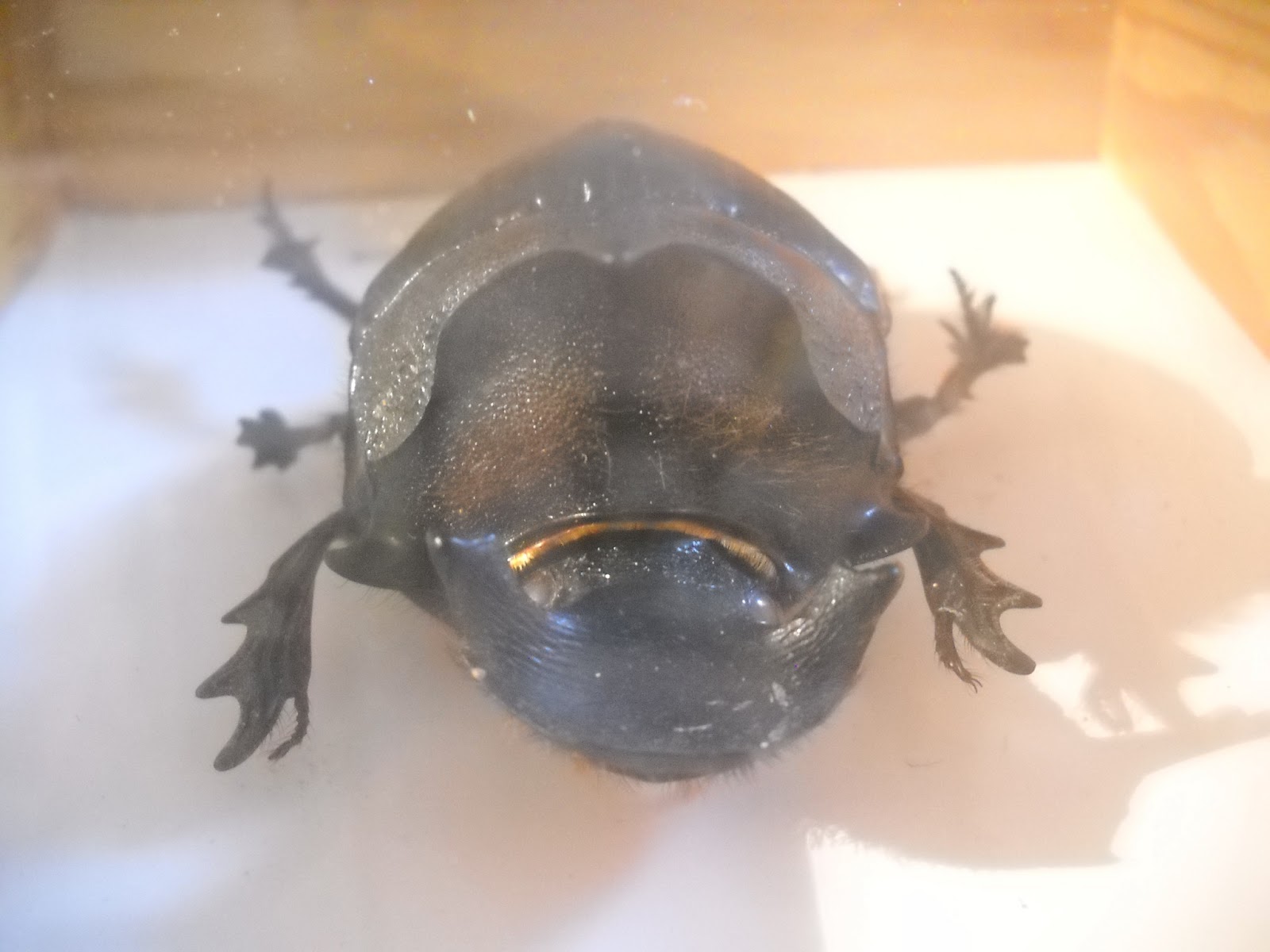
The dung beetles
are some of the more famous members of family Scarabaidae. They’re widely
renowned for their peculiar habit of rolling, living in, and even eating packed
balls of animal feces. Of the thirty thousand known species of scarabs, seven
thousand are dung beetles, and despite their distasteful eating habits, they’ve
been rightly recognized by human societies throughout the centuries as a
beneficial insect. A single dung beetle is capable of burying two hundred and
fifty times its own weight in the course of one night, thus sanitizing its surroundings
and reducing breeding grounds for flies. Most dung beetles are capable of using
any type of animal feces, though most tend to prefer herbivore waste and a
certain few have very particular tastes. The elephant dung beetle, as its name suggests,
has a preference for elephant feces, while a species known as Zonocopris
gibbicolis feeds solely on snail waste (and will subsequently hitch rides on
the backs of said snails). Dung beetles are generally separated into three
separate types—dwellers, tunnelers, and rollers. The dwellers do simply
that—they dwell in the piles of animal waste that they find, and use it as food
for themselves and for newly-hatched grubs. The tunnelers live in dung piles as
well, but they create burrows underneath the piles and drag what they can of
the waste down with them for their pantries and nurseries. Rollers are the most
famous—as their name suggests, they’re the ones who pack their findings into
orange-sized dung balls, stand on their front legs, and roll their treasure
back to burrows that they build away from the original dung pile.
Dung beetles have
developed specialized physical traits to suit their various lifestyles. The
rollers, when pushing their food around, tend to stand on their front legs with
their back legs serving as hands. Since the beetle’s weight subsequently rests
entirely on the front legs, they’ve developed thick, stubby forelegs with
fluted edges to brace against the ground. Male dung beetles are also known to
steal dung balls from one another, so they’ve developed plated spikes on the
tops of their thoraxes designed for charging down rivals. They all tend to have
flat, spade-shaped heads, perfect for burrowing and shoving aside dirt as they
tunnel.
The mythology
behind the dung beetle was centered mostly in ancient Egypt. It was associated
with the god Khepri—one of the manifestations of the sun god Ra in his journey
through the underworld—who was said to roll the sun across the sky each day
after being born anew from the earth. This idea came, as one might expect, from
their habit of rolling large spheres of dung across the ground for no apparent
reason, and the apparent ability of their grubs to ‘create’ themselves by
popping up out of their ground after pupating within their burrows. The
Egyptians honored Khepri with statues, amulets, and murals in their temples and
tombs, oftentimes adorned with multicolored wings. The winged scarab was given
a special place in the mummification rites for which the Egyptians were so well
renowned—it was depicted as an amulet, usually made from lapis lazuli or
turquois and inlaid with the glasslike material known as faience, and was bound
over the heart of the corpse among the wrappings as protection against the
heart bearing witness against the deceased in the hall of judgment. Hence the
name—“heart scarab”. More often than not, these amulets were stolen by grave
robbers not long after burial, along with everything else in the tomb.

I’m fairly certain I
will be accused of picking disgusting topics for the Things from the Shelf
posts at some time or other, and, admittedly, that is true. That won’t stop me
from writing more, though. My shelf is still plenty full of unexplored research
topics, and I have every intention of taking advantage of that. If you have
comments or questions to offer, feel free to leave them in the comments section
below, and I encourage my readers to share to Facebook.
Happy reading!
Sources:
Sources:
Sunday, May 12, 2013
Metamorphosis
Metamorphosis
By S.R. Koch
People
always ask the wrong questions. “What is the meaning of life?” is the most
common. Philosophers and other great thinkers tend to worry and ponder over the
big questions, when in truth, it’s the little ones they should be asking. “Why
do socks always disappear in the laundry?” is a good question, and happens to
be one that I can actually explain. There are other questions, of course, like,
“Why does toast always land buttered-side down?” or “How do cats always know
when you don’t want to be bothered?” Those ones, unfortunately, I can’t answer,
though I suspect there’s someone out there who can. Someone who, like me,
stumbled into something they weren’t meant to see.
It was the middle of February, and
about three months after my eighth birthday. It had been a cold year, and though
I don’t normally mind snow or cold, the fact that our socks seemed to be
disappearing at an unusually rapid rate was becoming really irritating. Nine
days out of ten, I had to wear mismatched socks, and my poor mom was making
weekly runs to the local department store to buy bags of socks for everyone. It
was ridiculous, and it never seemed to matter how careful my mom was when she
was loading the washer. The socks just vanished, and even after several
searches behind the dryer and numerous sweeps of the corners of the laundry
room, we could never find them again. I suspected that my dog was stealing them
out of the hamper or that my brother was playing a joke on everyone, so I came
to the conclusion any sensible person would; I needed to go on a stakeout.
At age ten, I was a slightly unusual
specimen of my gender in that I had absolutely no interest in ponies,
princesses, or dressing up dolls. My passion was spying, and my Barbies were
usually armed with GI-Joe weapons and sent on daring missions around the house.
I owned a dozen code-writing books, I had secret notebooks with invisible-ink
pens for all my spy information, and even a pair of night-vision binoculars
that my parents bought me for Christmas. Seeing the strange sock shortage as a
perfect opportunity to exercise my spying skills in a real-life mission, I went
to work full of excitement.
Our laundry room is a small, cramped
room that actually used to be an oversized closet. The washer and dryer take up
one entire wall, while the other wall has a huge shelf structure with storage
cupboards all along the top. It is there that we keep the canned veggies that
we harvest from our garden every year, along with spare quart jars and a couple
huge, black pots. I’ve discovered, through intense games of hide-and-seek at my
birthday parties, that I can fit into the cupboards if I scrunch my knees up to
my chin and squeeze myself between the two big pots. It’s a perfect place to
hide, because the divider on the door hides me even if the door is opened, and
if I leave it open a crack, I have an excellent view of the room. I use the
place whenever I need to avoid practicing piano or when my brother’s being a
jerk. No one, to this day, has ever discovered it.
On the night of the stakeout, I
waited until my mom had kissed me goodnight and both she and my dad had gone to
bed. I then, very carefully, rose, grabbed my spy pack from under the bed, and
padded downstairs on bare feet so as not to make a sound. I left all the lights
off, and clambered into the cupboard mostly by touch. It was a tight fit and
hard to do without light, but I eventually got myself in and was able to settle
down with my notebook and invisible ink pens in my lap and my night binoculars
in my hand. I was all set.
For the first half hour, my
excitement kept me awake and eager so that I didn’t even notice how cramped I
was. I scanned the room with my binoculars every five minutes, and I kept
running scenarios through my head where I leaped from the cupboard and caught
the sock thief red-handed when he attempted to make off with the contents of
the laundry hamper. Some of the stories I came up with were pretty exciting,
and often involved some ulterior motive for stealing the socks that was usually
along the lines of there being a secret code or priceless jewel hidden in with
our dirty clothes. I had a pretty fantastic imagination, but truth be told, I
think my stories were rather tame in comparison to what really happened.
My exhilaration kept me going strong
for little over half an hour, but at around ten-thirty, I suddenly realized
that my butt had gone numb. As my excitement eventually waned, so did my
enthusiasm. I checked the room less and less often, and shifted a lot in a
futile attempt to relieve the various numbed surfaces on my back, legs, and
rear. I began thinking more and more of my bed. I thought of how soft and comfy
the covers were, and of how much cooler my bedroom was than that stuffy little
cupboard. I began noticing every sharp corner and angle poking into me from all
sides, and soon that was all my brain could focus on. The only reason I didn’t
leave was because I was, and remain to this day, one of the most stubborn
people on the planet. I was sleepy, too, but I couldn’t drift off because of
all those corners poking me. In the end, it’s a good thing they were.
Otherwise, I never would have seen what happened next.
I don’t know what time it was,
really, but I like to think that it was midnight. Sleep was actually beginning
to overcome discomfort by that point, and I had my chin resting on my chest
despite a bad neck cramp, my eyes slowly drooping closed. I was just about to
drift off entirely, when the sound of something moving in the darkness caught
my attention, and I jolted awake with an electric tingling of fear and
excitement.
The sock thief had arrived.
Very quietly, I moved my binoculars
up from where they’d been resting on my knees and trained them on the crack I’d
left in the door. From there, I could clearly see the sliding door that led
into the room, the laundry hamper, and one corner of the washing machine. Since
I was expecting my thief to come through the door, I focused on that. You can
imagine my surprise when the brief flash of movement that I caught in the
corner of my night binoculars came from somewhere entirely different—the
hamper.
The lid had jumped.
Startled, I quickly swung the
binoculars around to look at the hamper, just in time to see the lid snap closed.
I frowned, confused, and squinted through the lenses.
A soft rustling on the floor drew my
attention away from the hamper, and I quickly shifted my gaze to the base of
the wash machine. I just caught a glimpse of something scooting out of sight
behind a mop bucket. In the green of the night binoculars, I couldn’t tell what
color it was, but it was small and long of body, like a rat. A sour feeling of
uneasiness settled on me at the thought that there might be rats in the room
with me, and suddenly my stake-out was beginning to seem like a really bad
idea. Another snap from the hamper made me jump slightly, my nerves tingling.
I still couldn’t see what was making
the hamper open and close, so I decided to watch and wait for it to happen
again. I stared at it for a full minute, ignoring the soft rustling noises from
the floor and the rising sense of panic building in the back of my throat. My
eyes started to water from holding them open for so long, and I think I was
holding my breath. I was just on the verge of blinking and heaving a loud gasp
of air when the lid opened again, and I finally saw what had been making the
noises.
A sock.
I recognized it—one of my white ones
with a blue heel and toe and a gaping hole where my big toe had poked through.
It slid through the gap that it made by pushing the toe end of its body against
the lid, and then crawled, inchworm-style, down the side of the hamper towards
the floor. It looked to be in a hurry.
There were now three of them
gathered on the floor, including the newcomer. The first two—both big ones from
my dad—had come out of hiding from behind the mop bucket, and were sitting in a
loose half-circle with their toe-ends facing inward. They looked like a
gathering of flat, oddly-colored caterpillars. I heard the hamper snap twice
more, and two more socks joined the first three—one from my mom, and one from
my brother. The five of them sat in their little circle, occasionally waving
their front ends in a manner that looked to me like some form of greeting. At
that point, I still wasn’t entirely sure what I was watching; they looked as if
they were gathering together for some purpose, yet they hadn’t done anything
since they’d crawled out of the hamper. A minute later, however, I figured out
what was going on.
As if by some sort of signal, all
five sock-caterpillars suddenly let themselves drop flat against the floor, and
they all stopped moving. I watched, fascinated, as they began to spin some sort
of silky thread from the heel-ends of their bodies, each of them encapsulating
itself in a cocoon of silk. Soon, all five where completely covered, and the
flow of silk stopped. All that was left was five white, bean-shaped lumps on
the floor in a little circle.
I was absolutely ecstatic; I was
witnessing the metamorphosis of socks. It was just like the monarch butterflies
that we sometimes caught as caterpillars and raised to adulthood, only it was
taking place over the course of a few hours. All thoughts of my soft, comfy bed
were long gone, and I waited expectantly for the cocoons to hatch and for the
adult form of the sock creatures to emerge.
I
didn’t have to wait long—after all, the change had to be done quickly in order
to avoid detection by humans, so it stood to reason that it wouldn’t take long
for the adults to develop in their little cocoons. Within an hour (which went
by in the blink of an eye), the cocoon that my sock had spun was beginning to
hatch. A long, ragged crack appeared down the side of the white surface, and a
segmented leg poked its way through the shell of hardened silk. The legs were
immediately followed by a big, furry head with feathered antenna mounted on top
and tiny, black, beadlike eyes positioned directly below the antenna. The
thorax followed the head, along with the creature’s fat, fuzzy abdomen and the
drooped, rumpled form of its wings.
Two others—my mom’s and one of my
dad’s—were beginning to hatch by this point, and the remaining two were
beginning to wiggle and rock. As the two latest ones tugged their way free,
mine proceeded to twitch and shiver its rumpled wings, drying them out and
removing the creases. By the time the last two had begun to crawl out of their
cocoons, mine was completely dry, and was giving little experimental flutters
of its wings.
The entire creature, though cast in
green by my night binoculars, was a pale, off-white color from head to abdomen.
Its wings were the same color, with odd, cross-hatched lines running up and
down their length. The tips of each lobe of its wings were dark blue in color, with
patterns at the base that looked suspiciously like stitch marks. As my mom’s
sock slowly unfurled its wings, I noted that it was a bit different—the
wingtips were dark gray instead of blue. Each sock-moth, I realized, matched
the pattern of the sock that it had changed from, down to the spiderman pattern
on my brother’s red and blue sock.
When all five of them were completely
hatched, they promptly set about eating the remains of their cocoons. Their
strange, multicolored wings shivered as they audibly munched on the dried husks
of silk, making them almost look like a flock of pigeons (they were, as you
might imagine, quite huge). When they were done with that, they proceeded to
test out their new winds, hopping and fluttering about across the laundry room
floor in gradually-lengthening bursts of short flight. I was so entranced by it
all that I didn’t even noticed that I had been unconsciously leaning forward
against the door, balancing on my toes with my free hand gripping one of the
big black pots for support. I suppose what happened next was inevitable.
I eventually reached the point where
I was leaning just an inch too far over my center of balance, and my weight
became too much for the pot. With a startled shout, I began to fall forward,
the cupboard door flying open under my weight and the heavy metal pot falling
out after me as I tumbled out into the open, my eyes wide.
I never saw what happened to the
sock-moths—I was too focused on the assortment of jars and sharp corners that I
caught on my way down. I managed to curl into a fetal ball on the trip
floorwards so as not to injure myself too badly, but the corners and edges that
I hit left some uncomfortable bruises, and I must have knocked every jar on the
shelf off to judge by the noise. Me, the black pot, a dozen jars of canned
beans and some other random things that had been stacked on the shelf all hit
the ground at roughly the same time, producing an almighty crash of metal and
shattering glass that could have woken the dead. I just sat there, stunned, and
watched the patch on the floor where the sock-moths had been. They’d fled, as
could be expected, though where to, I never found out. A minute later my mother
burst into the room, and promptly shrieked in horror when she saw the state of
me and the laundry room.
I tried to explain—how I’d noticed
the unusual number of missing socks and how I’d done the stakeout to catch the
thief, and then how the socks had crawled out of the hamper and turned into
moths. I did it calmly and with plenty of descriptive facts to back up my
claims, yet I might as well have not spoken. My mom, and no one else for that
matter, believed me—there wasn’t even a shred of cocoon silk left on the ground
as evidence of the strange nighttime transformation—and I was accused of
stealing the missing socks in order to make up the story. Never mind that one
of them had been my own. In the end, I was given a bath and sent back to bed,
and my night binoculars were taken away for a week as punishment for trashing
the laundry room.
I knew I was right, though.
I’ve tried, multiple times, since
that day, to catch the metamorphosis of sock-caterpillars again. Ours must have
moved somewhere else, though, since I never saw them in the laundry room again.
I suppose I don’t blame them; after all, I intruded on something no human is
meant to see, and in order to protect themselves, they had to find somewhere we
can’t find them to go about their business.
In the end, I answered one question:
“Why do socks always disappear in the laundry?” Yet I ended up asking a hundred
more. For instance, “How do cats
always know when you don’t want to be bothered?” and “Why does toast always land buttered-side down?”
Or even, “If socks can turn into
butterflies, what does it mean when one’s underwear goes missing?”
Perhaps, someday, we’ll find out.
THE
END
Subscribe to:
Posts (Atom)